
Real inclusivity has to go further than window-dressing
I had high hopes for
, the new book published by Routledge. It’s positioned as an authoritative guide to neurodiversity – the blurb calls it an ‘accessible and definitive resource’. It promised to combined knowledge and lived experience, and to be truly inclusive.
The first hint that something might not be quite right came when I was reading the bios of those who contributed. The contributors all recounted their qualifications, rather like a CV. First class honours degrees, setting up businesses and charities, professional careers in nursing, social work, teaching and music production. These were a group of highly capable, multi-lingual and multi-talented people from around the world. Great, but not representative of many of the autistic people I have met and I work with. There was no one who reported living in supported housing, or having attended a specialist school. No one attended a day centre. Not particularly inclusive, it seemed to me.
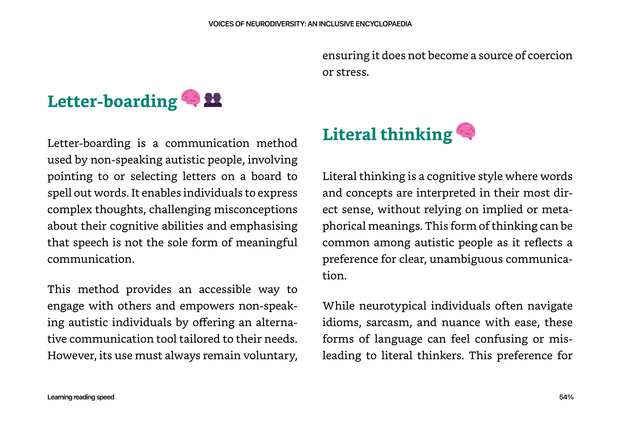
There was a single person with an intellectual disability included, and he, it was explained, used letter-boarding to communicate. Letter-boarding is a form of facilitated communication, where a nonspeaking person spells out words on a board held by a facilitator. Facilitated communication looks convincing, and many books and blog posts have been written this way.
The encyclopaedia lists Letter-Boarding with no acknowledgement of the (non-existent) research base or the controversy. It does not mention the position of the many international organisations who oppose it.
Repeated scientific studies have shown that facilitated communication (FC) is influenced by the facilitator and cannot be taken to be the independent voice of the nonspeaking person (Schlosser et al, 2014). Blinded studies show that when the facilitator does not know the answer to a question, the nonspeaking person is not able to give it via FC.
For this reason, facilitated communication is not recommended by organisations around the world. Here’s a
of those who oppose it. They don’t oppose it because they don’t believe in autistic people. It’s because it can be harmful and there is no evidence that it works.
Facilitated communication does not allow people to find their voice, it takes away their voice and instead imposes the facilitator’s voice. Facilitators do not do this consciously, most of them truly believe that this is the voice of the nonspeaking person. Unfortunately the data does not support that this is what is happening. The encyclopaedia makes no mention of the evidence base.
Facilitated communication is harmful because it replaces methods where a non-speaking person is helped to genuinely communicate, and also because
via FC that have torn families apart. These have later been proven to be completely unsubstantiated.
have assumed sexual consent via FC, when the nonspeaking person was not capable of consenting.
The other way that FC is harmful is through what is happening in this book. FC gives the impression of inclusion when it is not really there. We cannot assume that text generated by FC is the authentic voice of a nonspeaking person. There are no other voices of those with intellectual disabilities in this encyclopaedia, and there should be no ‘definitive resource’ about neurodiversity which excludes them. They may be harder to include and harder to find, because they don’t have blogs and they aren’t writing books. They can’t fill in online surveys. That’s one of the reasons why they are under-represented in research.
To be inclusive, we have to do better than this.
Reference
Schlosser RW, Balandin S, Hemsley B, Iacono T, Probst P, von Tetzchner S. Facilitated communication and authorship: a systematic review. Augment Altern Commun. 2014 Dec;30(4):359-68.